
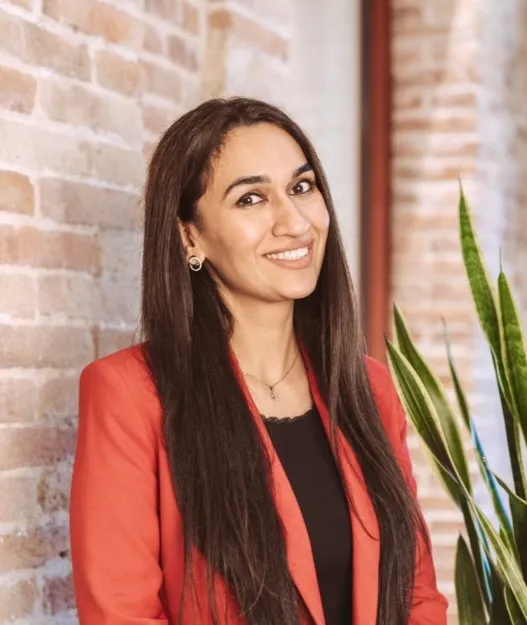


What happens when money thinks for itself? Amna Usman Chaudhry began asking that question in 2024, when artificial intelligence was still mostly discussed as a productivity tool for finance. To her, it pointed to something much larger: a future in which intelligent systems would analyse, decide and act within financial markets and institutions. It also raised a second question that would matter just as much. Who remains accountable when those systems begin making decisions together?
Those two questions have guided her work ever since. Trained as a financial economist, Amna has spent more than a decade where finance meets emerging technology, from blockchain and digital assets to artificial intelligence and programmable financial infrastructure.
“I’ve learned that original ideas often begin by noticing the question everyone else has walked past,” she says.
Her search for answers led her to Autonomous Finance, which she defines as the evolution of financial systems in which financial agency extends beyond direct human operation to autonomous systems that can interpret intent, make or coordinate decisions and initiate financial actions, under varying degrees of human oversight.
Strategic foresight sits at the heart of her approach. Since 2022, she has been saying that we still tend to look at emerging technologies separately, while the real transformation happens where they converge. AI is changing financial agency, or who and what can analyse, decide and act. Blockchain, programmable money and digital assets are changing how value moves. Quantum computing will eventually change both the computing power available to these systems and the cryptography they rely on for trust. Together, they form the emerging architecture of Autonomous Finance.
Existing models offered few answers for a future where multiple intelligent systems could make decisions together. To help fill that gap, she developed KYS: Know Your Swarm, a governance framework that gives regulators and financial institutions a practical way to think about accountability when decisions emerge from networks of AI agents acting together. She has since extended it with a Fairness Layer, which examines how bias and exclusion can emerge through the interactions between AI systems. “I work to develop accountability frameworks before autonomous systems reach mass adoption,” she explains. “Responsible innovation and inclusive innovation are the same project.”

As more people began asking the same questions, opportunities emerged to contribute to United Nations discussions, advise organisations, give guest lectures to postgraduate students and help shape broader thinking around AI governance.
Being named twice to the Innovate Finance Women in FinTech Powerlist reflected that growing influence, although watching unfamiliar ideas become part of mainstream thinking remained the greater reward.
What happens when money thinks for itself? Amna Usman Chaudhry began asking that question in 2024, when artificial intelligence was still mostly discussed as a productivity tool for finance. To her, it pointed to something much larger: a future in which intelligent systems would analyse, decide and act within financial markets and institutions. It also raised a second question that would matter just as much. Who remains accountable when those systems begin making decisions together?
Those two questions have guided her work ever since. Trained as a financial economist, Amna has spent more than a decade where finance meets emerging technology, from blockchain and digital assets to artificial intelligence and programmable financial infrastructure.
“I’ve learned that original ideas often begin by noticing the question everyone else has walked past,” she says.
Her search for answers led her to Autonomous Finance, which she defines as the evolution of financial systems in which financial agency extends beyond direct human operation to autonomous systems that can interpret intent, make or coordinate decisions and initiate financial actions, under varying degrees of human oversight.
Strategic foresight sits at the heart of her approach. Since 2022, she has been saying that we still tend to look at emerging technologies separately, while the real transformation happens where they converge. AI is changing financial agency, or who and what can analyse, decide and act. Blockchain, programmable money and digital assets are changing how value moves. Quantum computing will eventually change both the computing power available to these systems and the cryptography they rely on for trust. Together, they form the emerging architecture of Autonomous Finance.
“When I began speaking about Autonomous Finance, many people still viewed AI only as a tool that assisted financial institutions. Few imagined it actively participating in financial systems,” she recalls. “I spent as much time explaining why the questions mattered as proposing answers.”
In 2026, she submitted KYS: Know Your Swarm as written input to the consultation for the inaugural United Nations Global Dialogue on AI Governance. Work that had begun as independent research was becoming part of an international discussion about the future of intelligent systems.
“What made the moment meaningful was what it confirmed,” she says. “You do not need to sit inside an institution to help shape what institutions decide.”

Alongside her independent research, Amna serves as a UNESCO Women4Ethical AI Expert and was selected for the network’s inaugural Multi-Stakeholder Coordination Group for 2026-2028, contributing to international dialogue on the ethical governance of artificial intelligence.
Giving back has become just as central to her work. She mentors in GovStack’s Women in GovTech Challenge, a global programme supporting women from more than 80 countries to design inclusive digital public services. In 2026, she joined the inaugural RiseUp at Money20/20 Middle East in Riyadh, the first time the global community for women in financial services had come to the MENAP region, speaking on a panel about women driving AI innovation in fintech. For Amna, these conversations matter because they shape who gets to build the next generation of financial systems, and whether innovation widens financial inclusion or leaves existing gaps behind.
Good ideas are not defined by where they begin, which is why creating more opportunities for women working at the frontiers of technology has become such an important part of her work. Every new voice strengthens the conversation.
“When younger women see women leading at the frontier, they’re more likely to imagine themselves joining these industries and defining them.”
Ask Amna where finance is heading, and the conversation quickly turns toward Autonomous Finance. Intelligent agents will increasingly negotiate transactions, assess risk, coordinate activity and interact with one another on behalf of people, institutions and, eventually, other intelligent systems.
“AI is changing who, or what, can make financial decisions,” she says. “Quantum will change the foundations of trust those decisions rely on. Strategic foresight means recognising these signals early enough to prepare for how they may converge, whatever the timeline.”
Looking back, the milestones that shaped her career rarely began with certainty. Almost all of them began with a question, and asking those questions early has become the work that defines her.
Her advice to women entering emerging industries reflects the same curiosity. “Stay curious. Emerging fields are shaped by people willing to think independently, publish their ideas and contribute long before there is consensus. The perspective you bring may be your greatest contribution.”
“The future is Autonomous Finance,” she says. “The perspective must remain human.”
autonomousfinance.substack.com